The CAP Theorem

The CAP Theorem
Introduction
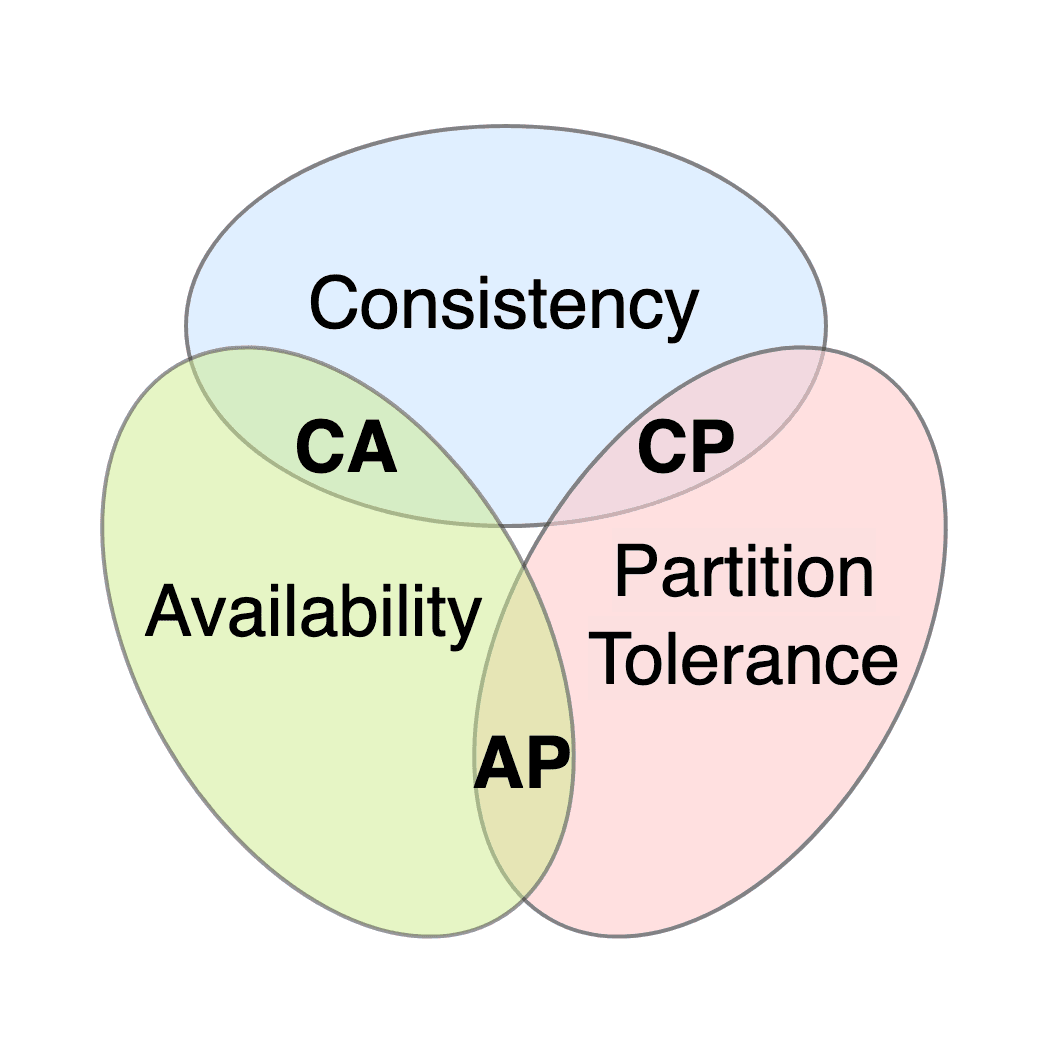
The CAP theorem says that a distributed system can deliver only two of three desired characteristics: consistency, availability, and partition tolerance — the 'C,' 'A,' and 'P' in CAP. That's the version that fits on a slide, and it's also the version that has caused twenty years of confused architecture discussions. The theorem is real — Eric Brewer conjectured it in 2000, and Seth Gilbert and Nancy Lynch proved it formally in 2002 — but what it actually proves is narrower, and more useful, than the slogan suggests.
What the Theorem Actually Says
Start with precise definitions, because the informal ones are where the confusion begins.
Consistency, in the CAP proof, means linearizability: every read returns the most recent completed write, as if all operations executed one at a time against a single copy of the data. This is a much stronger property than what most people mean when they casually say "consistent," and it is not the C in ACID — that C refers to integrity constraints within a database, an entirely different concept that shares nothing but the letter.
Availability means every request received by a non-failed node produces a response — not an error, not a timeout, a real answer. Note what this doesn't say: nothing about latency. A system that answers every request in ten minutes is CAP-available, which is your first hint that CAP-availability and what your users call availability are different things.
Partition tolerance means the system continues operating when the network loses or arbitrarily delays messages between nodes. And here is the key point that the "pick two" framing obscures: partition tolerance is not optional. Networks partition. Switches fail, cables get cut, a garbage collection pause makes a node unresponsive long enough to be indistinguishable from a network failure — from the perspective of the rest of the system, a long GC pause is a partition. You cannot choose "CA" in any system that runs on more than one machine, because you cannot choose for the network to be reliable.
So the theorem, correctly stated, is this: when a partition happens, you must choose between consistency and availability. That is the entire content of the proof, and the proof itself is almost embarrassingly simple: if the network splits into two halves and a write lands on one side, the other side can either answer reads (staying available, but serving stale data — sacrificing linearizability) or refuse to answer until it can confirm it has the latest data (staying consistent, but sacrificing availability). There is no third option, because information cannot cross a partition.
CP and AP in the Real World
The classification of databases as "CP" or "AP" describes their default behavior during a partition.
CP systems sacrifice availability to preserve consistency. The coordination systems that infrastructure depends on — etcd (which backs Kubernetes), ZooKeeper, Consul — are the clearest examples. They run consensus protocols (Raft, ZAB) that require a majority quorum to make progress: in a five-node cluster split three-and-two, the three-node side continues operating and the two-node side refuses writes entirely. That refusal is the sacrifice of availability, and it is exactly what you want from the system holding your cluster's source of truth — a split-brain etcd would be catastrophically worse than a briefly unavailable one.
AP systems sacrifice linearizability to preserve availability. Cassandra, DynamoDB (in its default mode), and CouchDB descend from the design in Amazon's Dynamo paper: any replica can accept a write, partitioned replicas keep serving whatever they have, and when the partition heals, the system reconciles divergent histories using mechanisms like vector clocks, last-writer-wins timestamps, or application-level merge logic. The canonical use case is a shopping cart: it is strictly better to accept an item into a possibly-stale cart than to show an error page, because the failure mode — reconciling two cart versions later — is cheap, while the failure mode of unavailability is a lost sale.
Be skeptical of tidy classifications, though. Many systems don't sit cleanly in either box: MongoDB is conventionally labeled CP, but its actual consistency behavior depends on write concern, read concern, and read preference settings — and historical versions failed linearizability under partition in ways that Jepsen testing documented extensively. Jepsen's body of work is worth knowing about in general: it is the industry's independent audit of what databases actually guarantee under partition, and its findings routinely contradict the marketing page.
Tunable Consistency: Choosing Per Operation
The most practically important development in this space is that the C/A choice stopped being a property of the database and became a property of each request. Dynamo-style systems expose this as quorum arithmetic: with N replicas, a write acknowledged by W of them, and a read consulting R of them, the condition R + W > N guarantees that every read quorum overlaps every write quorum — so reads see the latest write, at the cost of higher latency and reduced tolerance for down replicas. Set R + W ≤ N and you've bought availability and speed at the price of possibly-stale reads.
In Cassandra this is a per-query consistency level: QUORUM reads and writes give you the overlap guarantee; ONE gives you speed and maximal availability; LOCAL_QUORUM scopes the quorum to one datacenter so that cross-region latency stays out of the hot path. The design consequence is worth internalizing: consistency is not an architectural decision you make once — it is a budget you spend differently on different operations. The account balance read before a withdrawal gets QUORUM; the product-view counter gets ONE; nobody has to pick a single answer for the whole system.
PACELC: The Part CAP Leaves Out
CAP only constrains behavior during a partition, and partitions — while inevitable — are rare. What about the other 99.9% of the time? Daniel Abadi's PACELC formulation completes the picture: if there is a Partition, choose Availability or Consistency; Else, choose Latency or Consistency.
The else-clause is the trade-off you live with every day. Synchronous replication to a replica 80 milliseconds away adds 80 milliseconds to every write, partition or not. That is why AP-leaning systems tend to replicate asynchronously (PA/EL — favor availability and latency), and why strongly consistent systems pay a latency tax continuously, not just during failures. When someone asks why the eventually-consistent configuration is faster when nothing is failing, PACELC is the answer: the latency cost of coordination exists at all times; CAP just describes its most dramatic moment.
Google's Spanner is the instructive extreme case. It offers linearizable transactions across datacenters worldwide — a PC/EC system — and achieves the availability numbers of an AP system not by evading the theorem but by making partitions extraordinarily rare: private global fiber, redundant paths, and the TrueTime API, which uses GPS receivers and atomic clocks in every datacenter to bound clock uncertainty so tightly that transactions can be ordered globally with bounded waiting. Spanner doesn't break CAP; it demonstrates that the theorem constrains what you promise when the network fails, and that with enough engineering (and money) you can make the network fail very, very rarely. When a partition does occur, Spanner chooses C — the minority side blocks.
The Consistency Spectrum
Framing everything as "strongly consistent or eventually consistent" flattens a spectrum that practitioners actually navigate at several intermediate points. Below linearizability sit progressively weaker — and progressively cheaper — models: sequential consistency (all clients see operations in the same order, though not necessarily in real-time order), causal consistency (operations that could have influenced each other stay ordered; concurrent ones may be seen differently by different clients), and the session guarantees that quietly do the most work in application code — read-your-own-writes (a user who just posted a comment sees it on refresh) and monotonic reads (a user never sees data go backwards in time between requests). Many systems that are eventually consistent globally offer these session guarantees per-client, which is frequently all the consistency a user-facing feature actually needs. Knowing this spectrum is what lets you avoid paying the full coordination tax for the weaker property you actually require.
Using CAP Well
Stripped of misconceptions, the theorem yields a short list of genuinely useful design questions. What happens to this operation during a partition — does it degrade to stale reads, queue writes for later reconciliation, or refuse service? Which of those failure modes is cheapest for this feature? Where merge-on-heal is the answer, who writes the merge logic — the database (last-writer-wins, with its silent data loss) or the application (explicit, but real work)? And for the data where refusing service is correct — inventory decrements, financial balances, coordination state — is the quorum machinery actually configured to refuse, or merely assumed to?
Teams that reason this way stop arguing about whether their database "is CP or AP" — a question that rarely has a clean answer — and start specifying per-operation behavior under partition, which is a question that always does.
Conclusion
The CAP theorem's popular form — pick two of three — is wrong enough to be harmful: partition tolerance is not a menu option, "CA" is not a real category for distributed systems, and the theorem says nothing at all about normal operation. Its correct form is modest and permanently relevant: when the network fails, each operation must choose between answering with possibly-stale data and not answering. Modern systems have turned that binary into a dial — quorum arithmetic, per-query consistency levels, session guarantees — and PACELC extends the reasoning to the latency trade-offs of everyday operation. Understanding this precisely is one of the clearest markers of distributed systems maturity: not because the theorem is complicated, but because using it well means asking, for every piece of state you own, exactly what should happen when the network — inevitably — lets you down.