Understanding the Differences Between Kubernetes, OpenShift, and Istio

Table Of Content
- Understanding the Differences Between Kubernetes, OpenShift, and Istio
- Introduction
- Kubernetes: The Reconciliation Machine
- Key features of Kubernetes include
- OpenShift: Kubernetes with the Decisions Made for You
- What OpenShift actually adds
- Istio: Taking Over the Traffic
- How Do They Work Together?
- Conclusion
Understanding the Differences Between Kubernetes, OpenShift, and Istio
Introduction
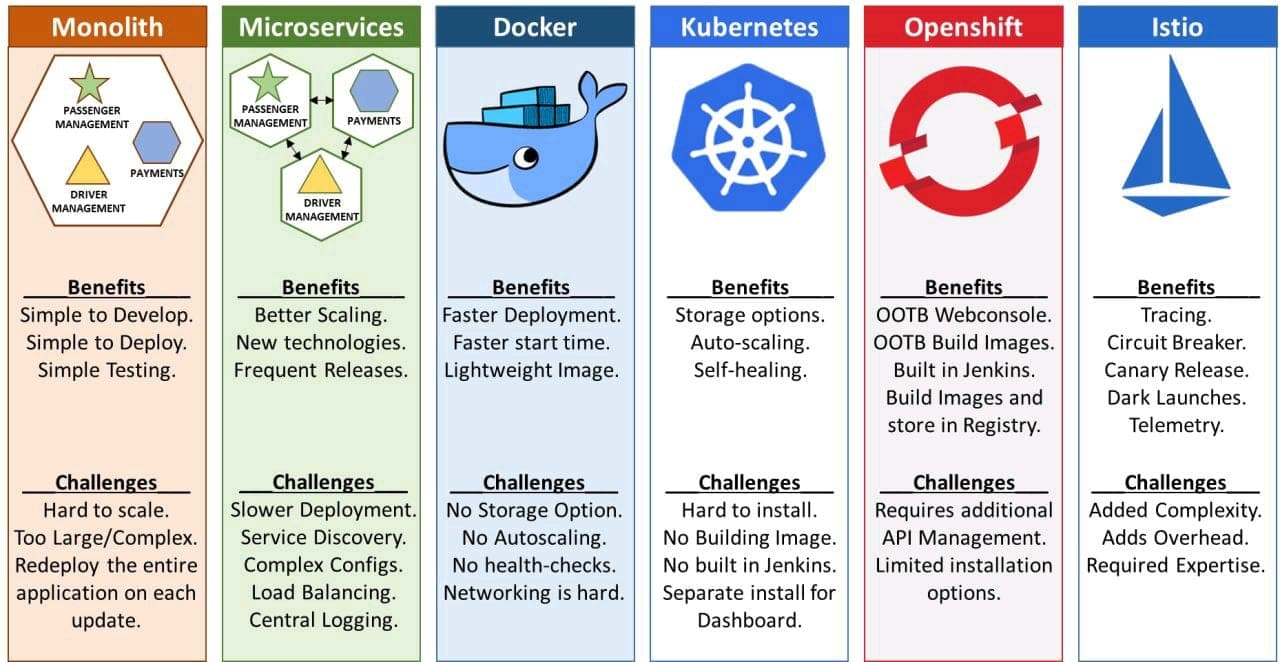
Kubernetes, OpenShift, and Istio get mentioned in the same breath so often that it's easy to assume they compete. They don't — they stack. Kubernetes is the orchestration engine; OpenShift is a distribution of Kubernetes with opinions and enterprise machinery bolted on; Istio is a service mesh that runs on top of either one and takes over the traffic between your services. Confusing the layers leads to real architectural mistakes — like buying OpenShift for features Kubernetes already has, or adopting Istio for a problem a load balancer already solves. So it's worth being precise about what each layer actually does, and what it costs.
Kubernetes: The Reconciliation Machine
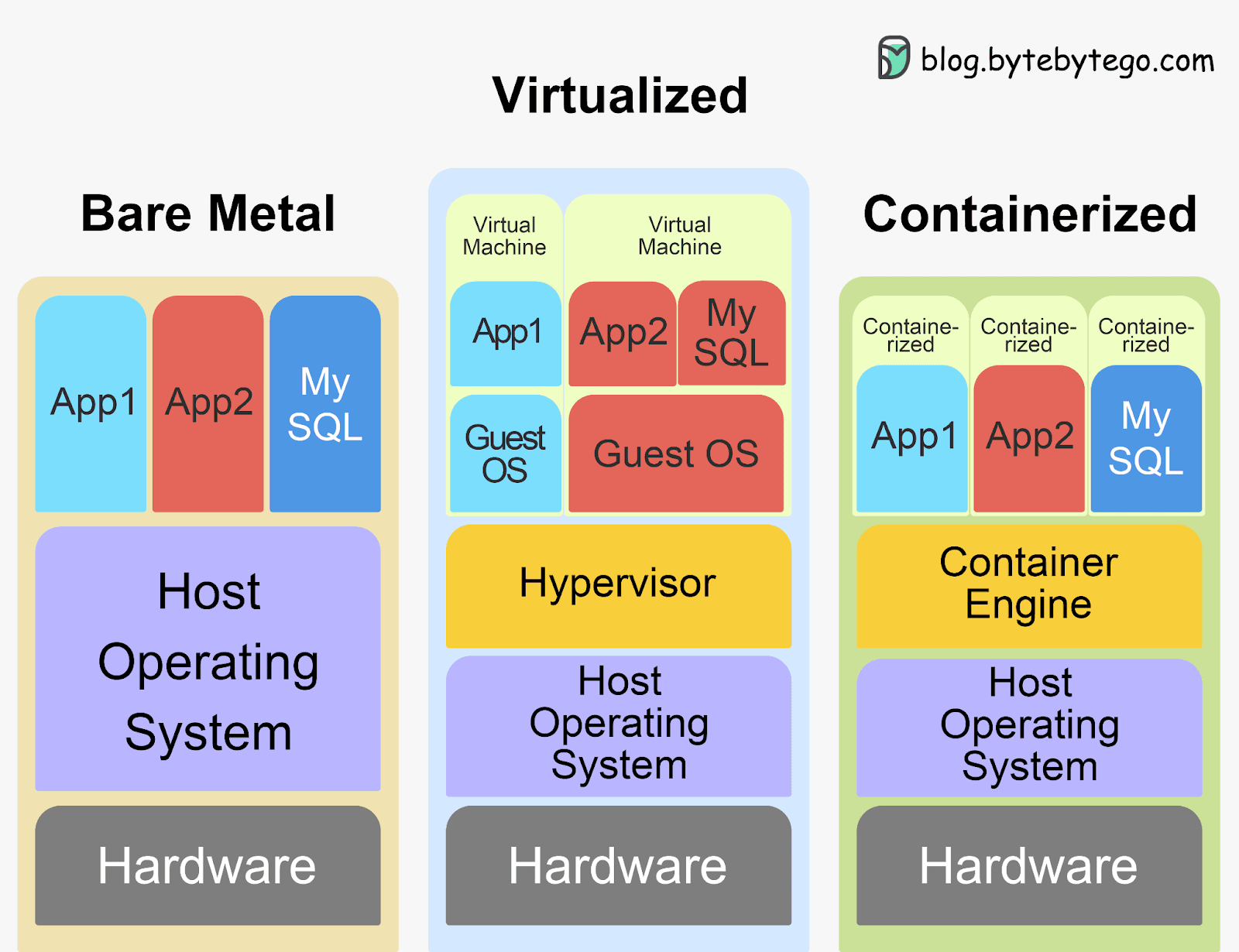
Kubernetes, abbreviated K8s, is an open-source platform for automating the deployment, scaling, and management of containerized applications. But the definition undersells the idea that makes it work. Kubernetes is, at its core, a reconciliation machine: you write a declarative description of what you want (in YAML, stored via the API), and a set of controllers runs an endless loop — observe actual state, compare with desired state, act to close the gap. Every headline feature is this one loop wearing a different costume.
Understanding the architecture makes the magic mundane, in the best way. The control plane consists of the API server (the single front door — every component and every kubectl command goes through it), etcd (the consistent key-value store holding the entire cluster state — the only stateful component, and the one whose loss is a genuine disaster), the scheduler (which assigns pods to nodes by filtering out infeasible nodes and scoring the rest), and the controller manager (the reconciliation loops themselves). On every worker node, the kubelet watches for pods assigned to its node and drives the container runtime to make them real, while kube-proxy (or the CNI plugin) programs the networking that makes Services work.
Key features of Kubernetes include
- Automated scheduling: the scheduler places pods based on resource requests, affinity rules, taints, and spread constraints. The operational detail that matters: scheduling runs on requests, not actual usage — a cluster full of over-requesting pods is "full" even when its CPUs sit idle, which is why request tuning is the first lever in any Kubernetes cost conversation.
- Scalability: the Horizontal Pod Autoscaler is another reconciliation loop — observe a metric, compare to target, adjust the replica count. Pair it with the Cluster Autoscaler (which adds nodes when pods can't schedule) and capacity management becomes two nested feedback loops.
- Resilience: "self-healing" is not a special subsystem; it is the loop again. A node dies, its pods stop reporting, the ReplicaSet controller notices fewer pods than desired and creates replacements, the scheduler places them elsewhere. Nobody "detects the failure" — the gap between desired and actual state is the detection.
The honest caveat: Kubernetes is a platform for building platforms. Out of the box it does not ship an ingress controller, certificate management, observability, secrets encryption worth the name, or CI/CD — every production cluster grows a curated stack of add-ons, and that curation is genuine engineering work. This gap between "Kubernetes" and "a platform your developers can actually use" is precisely the market OpenShift lives in.
OpenShift: Kubernetes with the Decisions Made for You
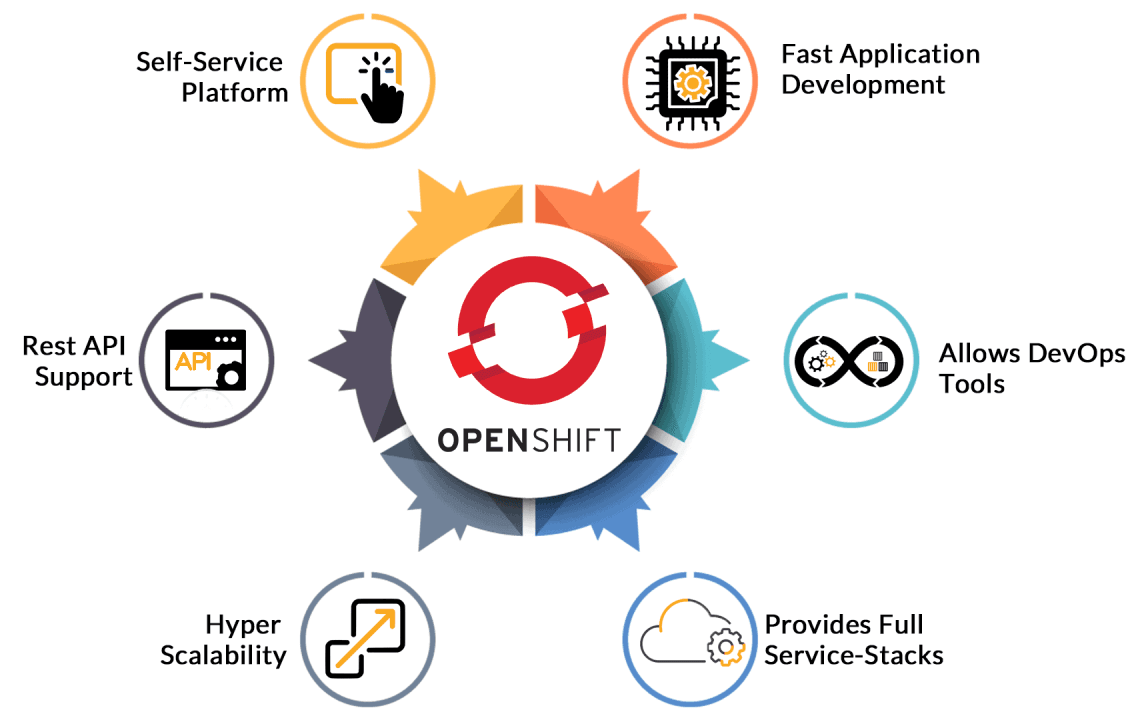
OpenShift, developed by Red Hat, is a certified Kubernetes distribution — real Kubernetes underneath, passing the same conformance tests — that ships with the add-on decisions already made, integrated, and supported: the container runtime (CRI-O), networking, monitoring stack (Prometheus/Grafana), logging, an integrated image registry, CI/CD tooling, and a developer web console that is genuinely better than the upstream dashboard. Like TypeScript over JavaScript, it is a superset: everything Kubernetes does, plus opinions.
What OpenShift actually adds
- Security defaults that bite until you understand them: OpenShift enforces Security Context Constraints (SCCs), and the default (
restricted) refuses to run containers as root and assigns each project a random UID range. The practical consequence every OpenShift newcomer discovers within the first week: public Docker images that assume root — or assume a specific UID — fail on OpenShift until rebuilt to tolerate arbitrary UIDs (group-writable directories, no privileged ports). This is friction, and it is also exactly the hardening most clusters never get around to configuring by hand. - Routes, and a history lesson: OpenShift's
Routeresource for exposing services externally predates Kubernetes Ingress, which is why both exist on the platform. Modern OpenShift supports standard Ingress and the newer Gateway API, but you will meet Routes in every existing cluster, and they remain more capable than basic Ingress for things like TLS re-encryption. - Builds in the cluster:
BuildConfigand Source-to-Image (S2I) turn source code into images inside the cluster — a genuinely different workflow from the mainstream (build in CI, push to registry), and one reason OpenShift shops often have simpler pipelines and less Dockerfile sprawl. - The Operator ecosystem as a first-class citizen: OperatorHub and Operator Lifecycle Manager make the "install a database/message queue/monitoring stack with lifecycle automation" experience coherent, where upstream clusters assemble the same from Helm charts and hope.
The real trade is not features — it's who holds the pager for the platform. Upstream Kubernetes plus hand-picked add-ons gives you maximum flexibility and makes you the integrator of record for every upgrade interaction between fifteen components. OpenShift gives you one throat to choke, a tested upgrade path across the whole stack, and a subscription bill. Regulated industries and large enterprises tend to find that math easy; small teams with strong platform engineers often go the other way. Both are correct.
Istio: Taking Over the Traffic
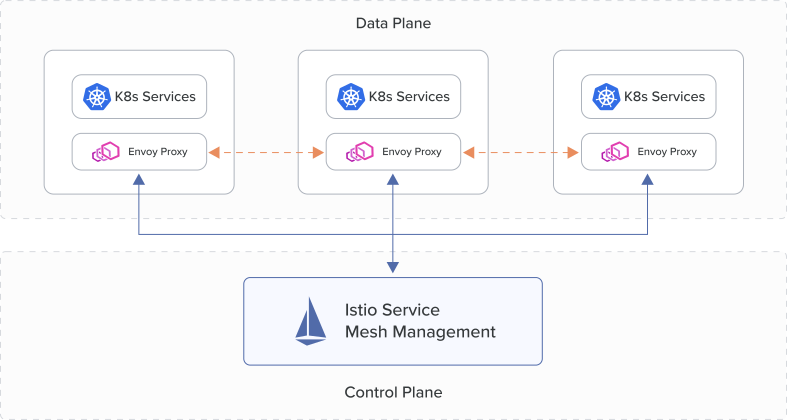
While Kubernetes and OpenShift manage workloads, Istio manages the communication between them — and it does so with a trick worth understanding precisely. In the classic sidecar model, Istio injects an Envoy proxy container into every pod and rewrites the pod's iptables rules so that all traffic, inbound and outbound, silently passes through that proxy. Your application believes it is talking directly to other services; in reality every byte crosses two Envoys (sender's and receiver's). The mesh's control plane, istiod, pushes configuration, service discovery data, and certificates to that fleet of proxies.
Everything Istio offers falls out of owning that traffic path:
- Traffic management: because the proxy makes the routing decision per-request, you get things Kubernetes Services cannot do: weighted canary releases (5% to v2, watch the dashboards), header-based routing, per-route timeouts, circuit breaking via outlier detection, and automatic retries. Retries deserve a warning label: naive retry policies stacked across multiple hops multiply — three retries at three layers is 27 attempts against a struggling service — which is how a mesh, misconfigured, converts a slowdown into a self-inflicted outage. Configure retry budgets deliberately.
- Security: the mesh issues each workload a cryptographic identity (SPIFFE-format, rotated automatically) and can enforce mutual TLS between all services without a single application code change — plus authorization policy on top ("payments accepts calls only from checkout"). For zero-trust initiatives this is the headline feature, because retrofitting mTLS into application code across fifty services is a multi-year project, and in a mesh it is configuration.
- Observability: since every request crosses the proxies, you get uniform metrics (rates, errors, latency percentiles per service pair), access logs, and distributed trace propagation for free at the network layer — with the caveat that traces still need apps to forward context headers.
The costs are equally concrete: an Envoy per pod consumes memory and CPU fleet-wide, adds a millisecond or two of latency per hop, and — more expensively — adds an entire distributed system to operate, upgrade, and debug. This is why the guidance from experienced operators is unfashionably boring: you might not need a mesh. A handful of services behind an ingress with NetworkPolicies does not. Dozens of services, compliance-driven mTLS requirements, or serious canary/traffic-shifting needs — that's where the mesh earns its keep. Istio's newer ambient mode (sidecar-less, with per-node proxies and optional per-namespace L7 proxies) exists specifically to shrink the resource and operational bill, and is worth evaluating for new adoptions.
How Do They Work Together?
The layering, made concrete:
- Kubernetes is the substrate: reconciliation loops turning declared state into running pods, services, and storage.
- OpenShift is a distribution of that substrate: same API, plus integrated build/registry/monitoring machinery, hardened security defaults (SCCs), and a vendor on the hook for the whole stack's upgrades.
- Istio is an overlay on either: it commandeers the network path between pods to provide routing, mTLS identity, and telemetry that neither layer below offers.
A concrete enterprise stack: OpenShift provides the cluster, the developer consoles, and the compliance story; Istio (or OpenShift Service Mesh, which is Red Hat's supported packaging of Istio) provides mTLS between services because the auditors require encryption in transit; canary deployments ride the mesh's traffic splitting while the platform's monitoring stack watches the error rates. Each layer is doing the one job the others structurally cannot.
Conclusion
Kubernetes, OpenShift, and Istio are three answers to three different questions. Kubernetes answers "how do I run and heal containerized workloads at scale?" — with a reconciliation model elegant enough that most of its features are one idea repeated. OpenShift answers "who assembles and supports the fifty decisions between Kubernetes and a usable platform?" — with opinions you pay for and occasionally fight. Istio answers "how do I control, secure, and observe the traffic between services without touching their code?" — at the price of running another distributed system. Keep the questions separate and the technology choices stop being tribal: adopt the substrate, buy the distribution if the support math favors it, and add the mesh when — and only when — the traffic problems are the expensive ones.