Becoming a DevSecOps Architect

Table Of Content
- Introduction
- What is DevOps?
- The Role of a DevOps Architect
- How to Become a DevOps Architect
- Educational Background
- Essential Skills
- Networking
- Operating Systems
- Security Principles
- Cloud Architecture Principles
- Cloud Computing Skills
- Learn DevOps Practices
- Continuous Integration/Continuous Deployment (CI/CD)
- Infrastructure as Code (IaC)
- Configuration Management and Observability
- The Skills Nobody Lists: Writing and On-Call
- Conclusion
Becoming a DevSecOps Architect: A Comprehensive Guide to DevSecOps, Site Reliability, and Cloud Infrastructure
Introduction
The cloud has become the backbone of modern IT infrastructure, offering scalable, reliable, and cost-efficient solutions for businesses of all sizes. As organizations continue to migrate their operations to the cloud, the demand for skilled professionals continues to grow with it — the public cloud services market is projected to reach $1.37 trillion by 2028, with a compound annual growth rate above 20%.
But market-size numbers don't tell you what the job actually is, and most "how to become a DevOps architect" guides are lists of tool names with no ordering and no opinion. This post is my attempt at the guide I wish I'd had: what DevOps actually means, what separates an architect from a senior engineer (it is not more tools — it is a different unit of work), and a skills progression in the order the skills actually build on each other.
What is DevOps?
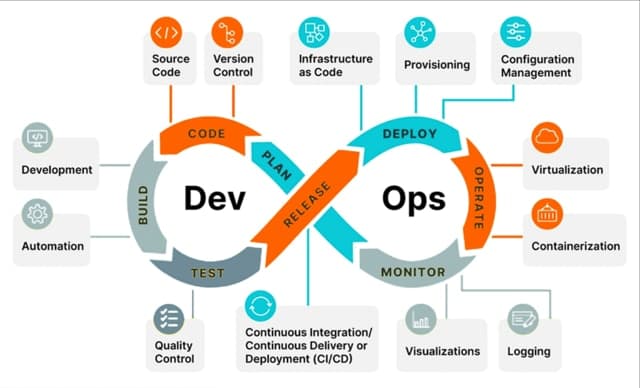
DevOps is the integration of development (Dev) and operations (Ops) within an organization to improve collaboration and productivity by automating infrastructure and workflows and continuously measuring application performance. The mechanical expression of it is continuous integration and continuous delivery (CI/CD) — but the underlying idea is about feedback loops: shortening the distance between writing code and knowing how it behaves in production, until deploying is boring and failures are small.
It's worth knowing the sibling disciplines, because job postings blur them and interviews don't. Site Reliability Engineering (SRE) is Google's formulation of operations as a software problem — its signature contributions are the SLO (a numeric reliability target), the error budget (the amount of unreliability you're allowed to spend on shipping faster), and the systematic elimination of toil. DevSecOps pushes security into the same feedback loops — scanning in the pipeline instead of an audit before release. Platform engineering is the newest label: building the internal platform (pipelines, templates, golden paths) that product teams build on. An architect ends up conversant in all three, because at the design level they are the same conversation.
The Role of a DevOps Architect
A DevOps Architect designs, implements, and manages cloud infrastructure, certifying systems are scalable, reliable, and secure — selecting platforms, integrating the pieces, managing costs, and treating security and compliance as design inputs rather than post-launch fixes. Beyond the technical layer, architects align cloud initiatives with the organization's goals and technology roadmap.
The clearest way I can describe the difference between a senior engineer and an architect: the unit of work changes from the solution to the trade-off. A senior engineer implements the Kubernetes cluster well. An architect decides whether Kubernetes is warranted at all — against the team's operational maturity, the hiring market, the compliance regime, and the three-year cost curve — and can defend that decision in writing to both engineers and executives. The deliverables shift accordingly: fewer pull requests, more architecture decision records, reference designs, and reviews of other people's plans. If the engineer's question is how, the architect's question is whether, and at what cost.
That's also why the role is unforgiving about fundamentals. You cannot evaluate trade-offs in systems you only understand at the marketing-page level — which sets up everything below.
How to Become a DevOps Architect
You need a solid foundation in IT and networking: how computers, servers, and networks interact, and the principles of data management and security. What follows is roughly ordered — each layer makes the next one learnable.
Educational Background
A degree in Computer Science, Information Technology, or a related field is beneficial but not mandatory — successful DevOps professionals come from everywhere, from no degree to PhDs. Certifications such as CompTIA Network+, CompTIA Security+, and Cisco Certified Network Associate (CCNA) can solidify your networking knowledge. Based on my personal experience, earning my Network+ and CCNA certifications greatly enhanced my understanding of networking concepts. However, these certifications are not essential to becoming an expert in the field. If I had to choose one, I recommend the Network+ as it provides a good overall foundation in networking basics.
One calibration note: certifications get interviews; they do not pass them. Every certification should be paired with something you built that exercises the material — the cert proves you studied, the project proves you understood.
Essential Skills
Networking
Networking is first for a reason: it is the layer where the most production incidents actually live, and the layer where weak fundamentals are hardest to fake.
- IP addressing and subnetting: design efficient addressing schemes and master subnetting. In the cloud era this shows up as VPC/VNet CIDR planning — one of the few decisions that is genuinely painful to change later, so architects are expected to get it right early.
- DNS: learn how resolution actually works — record types, TTLs, delegation — because DNS is both the top layer of most high-availability designs (health-checked failover, weighted routing) and the true cause of a comic fraction of "the app is down" incidents.
- VPNs and private connectivity: configuring and managing VPNs, and knowing when a dedicated circuit (Direct Connect, ExpressRoute) is warranted instead.
- Load balancers: distributing traffic across servers for availability — and the production details that interviews probe, like health-check behavior and L4 versus L7 trade-offs.
- Network protocols: TCP/IP deeply enough to reason about handshakes, timeouts, and retransmission; HTTP/S including TLS termination; SSH; and enough BGP awareness to understand how hybrid connectivity exchanges routes.
Operating Systems
- Linux, seriously; Windows, competently. The cloud runs overwhelmingly on Linux, so this is where depth pays: process management, permissions, systemd, filesystems, and reading
journalctlunder pressure. Windows expertise matters in enterprise environments — Active Directory and its cloud descendant (Entra ID) power most corporate identity. - Command-line fluency: the CLI is the job. Bash for Unix/Linux, PowerShell for Windows, and the muscle memory to chain tools (
grep,awk,jq,curl) into answers during an incident. - Scripting → programming: start with automation scripts, but aim for real programming competence — Python is the lingua franca, and Go increasingly dominates infrastructure tooling. The distinction that matters at the architect level: scripts automate tasks; programs (with error handling, tests, and structure) automate systems.
Security Principles
- Encryption: methods and protocols for data privacy and integrity — SSL/TLS for transport, AES (128/192/256) at rest — plus the key-management layer (KMS, rotation, envelope encryption) where real designs succeed or fail.
- Identity before firewalls: in the cloud, IAM is the perimeter. Least-privilege roles, short-lived credentials over static keys, and workload identity are the modern security backbone — most cloud breaches are credential and misconfiguration stories, not exotic exploits.
- Firewalls and network security: security groups, NACLs, and the public/private subnet topology that makes a database unreachable by construction rather than by rule.
- Compliance and standards: GDPR, HIPAA, SOC 2 — architects translate these from audit language into technical controls, and that translation skill is rarer and better paid than another tool on the résumé.
Cloud Architecture Principles
A cloud architect designs scalable, secure, and cost-effective solutions that meet business objectives.
- Scalability and performance: horizontal versus vertical scaling, load balancing, auto-scaling — and the underrated skill of knowing what not to scale (the boring monolith on three VMs is often the right design).
- Reliability as arithmetic: availability zones, regions, and the honest math of nines — every dependency multiplies failure probability, and "multi-region" is a cost-and-complexity decision, not a default. Frameworks like the AWS Well-Architected Framework and Azure's equivalent give you the standard vocabulary here; learn them, because reviews are conducted in their terms.
- Cost management: AWS Cost Explorer, Azure Cost Management, GCP's tooling — but the architect-level skill is designing cost visibility in from the start (tagging standards, showback) and knowing the classic traps: cross-AZ data transfer, NAT gateway processing, idle capacity bought "for safety."
Cloud Computing Skills
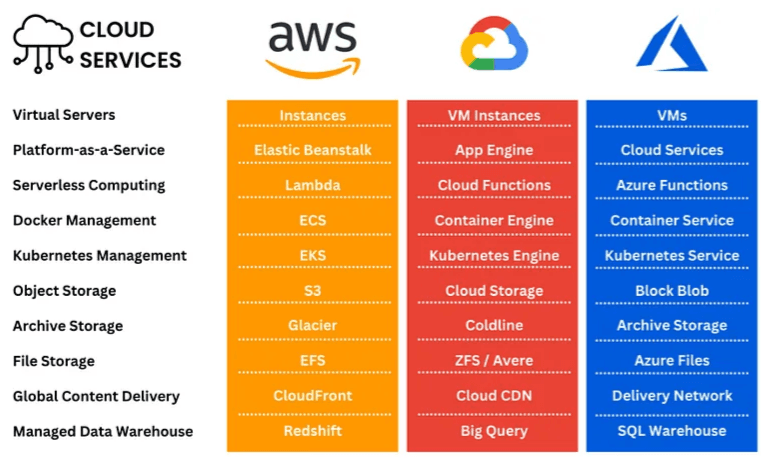
Cloud providers offer services that let businesses scale, manage, and deploy applications without heavy investment in physical hardware — virtual machines, virtual private clouds, managed storage, and hundreds of higher-level services on top.
Three providers dominate: AWS leads the market (roughly a third of it), with the broadest service catalog; Microsoft Azure holds the second position with unmatched enterprise integration — if a company runs on Microsoft products, it tends to run on Azure; GCP is smaller but strong in data and machine learning services. The foundational services rhyme across all three, which leads to my strongest practical advice: learn one provider deeply rather than three shallowly. Depth in one transfers in weeks; a survey of all three transfers nothing. Pick AWS for the broadest job market or Azure for enterprise environments, take it to the level where you can design and defend a real architecture on it, and let the second provider come with your second job.
Learn DevOps Practices
Continuous Integration/Continuous Deployment (CI/CD)
Continuous Integration means developers integrate code into a shared repository frequently, with every integration verified by automated builds and tests. Continuous Deployment extends this by automatically promoting passing builds toward production.
- Git beyond the basics: branching, merging, conflict resolution — and the workflow-design layer (trunk-based development versus long-lived branches) that architects are expected to have opinions about.
- Automation tools: GitHub Actions, Azure DevOps, GitLab CI/CD, Jenkins. The tools are interchangeable enough that the durable skill is pipeline design: what runs at pre-commit versus PR versus merge, what gates a deploy, how a rollback works.
- Deployment strategies: blue/green, canary releases, feature flags — the machinery that turns "we deploy on Fridays" from bravado into routine.
Infrastructure as Code (IaC)
IaC provisions and manages infrastructure through version-controlled code instead of manual processes — consistent, repeatable, reviewable.
- Terraform: the multi-provider standard, and the one I'd learn first. Go past the tutorial into what production demands: remote state with locking, modules, and the plan-as-code-review workflow.
- AWS CloudFormation and Azure Resource Manager/Bicep: the native options, worth knowing in whichever ecosystem you work — Bicep especially has become the clean choice for Azure-only estates.
- The architect-level insight: IaC's real payoff isn't automation, it's that the pull request becomes the change-management process — review, audit trail, and rollback come free with the workflow.
Configuration Management and Observability
- Ansible (and historically Puppet/Chef) automates system configuration — still relevant for VM estates, less central as containers make images the configuration unit.
- Containers and Kubernetes deserve explicit mention in any modern list: Docker fundamentals are now assumed knowledge, and Kubernetes literacy — even if you decide against it in a given design — is table stakes for architecture conversations.
- Observability: metrics, logs, and traces (Prometheus, Grafana, OpenTelemetry) — because the SRE half of the role runs on measurement. If you can't see it, you can't have an SLO on it.
The Skills Nobody Lists: Writing and On-Call
Two final things separate people who plateau at senior engineer from those who grow into architecture. The first is writing. Architecture is a writing job — decision records, design docs, incident reviews — and the ability to lay out a trade-off in one clear page is worth more than any certification on this list. Start by writing up your own projects and decisions; a blog like the one you're reading doubles as practice and proof.
The second is production scar tissue. Take the on-call rotation. Incidents are where systems teach you how they actually fail — where you learn that DNS TTLs are real, that retries can be a weapon pointed at yourself, that the monitoring gap is always where the outage is. Architects who have felt production break design differently, and better, than those who haven't. There is no course for this; there is only showing up for it.
Conclusion
Becoming a DevOps Architect is a rewarding career path with real growth and real intellectual range — but it is a progression, not a checklist. The fundamentals (networking, operating systems, security) make the cloud learnable; one deep cloud provider makes the practices (CI/CD, IaC, observability) concrete; production experience and writing turn practiced skills into judgment, which is the actual product an architect sells. Whether you're starting out or transitioning in, the journey is a continuous learning process — and the industry's growth means the demand for people who've done that learning honestly isn't slowing down any time soon.